
New publications
Preparations
Lanvis
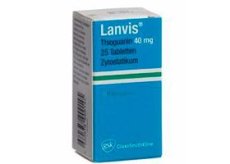
Lanvis is an antineoplastic drug, belongs to the category of antimetabolites.
 [ 1 ]
[ 1 ]
ATC classification
Release form
Available in tablets, 25 pieces per bottle. One package of the medicine contains 1 bottle.
Pharmacodynamics
Thioguanine is a sulfhydryl analogue of the substance guanine, which has properties similar to the purine antimetabolite. When activated, it is converted into a nucleotide - thioguanylic acid. The breakdown products of thioguanine slow down the binding of purines, as well as the process of interconversion of nucleotides of the purine series.
In addition, thioguanine is incorporated into the structure of nucleic acids and is therefore believed to acquire toxic properties. The active ingredient has cross-resistance with mercaptopurine, so it must be taken into account that patients with insensitivity to one of the drugs may be resistant to the other.
Pharmacokinetics
Thioguanine has a fairly strong metabolism in vivo. There are two main pathways for its biotransformation: the methylation process to form 2-amino-6-methylthiopurine, and the deamination process to form 2-hydroxy-6-mercaptopurine, which is further oxidized to form 6-thiouric acid.
When taking the drug orally at a dose of 100 mg/m2 , the peak plasma level is observed after 2-4 hours and is 0.03-0.94 nmol/ml. This value decreases if the drug is taken with food or if vomiting occurs.
Dosing and administration
The duration of the therapeutic course and dosage depend on the size of the dose and the type of other drugs used in combination with Lanvis.
Short courses of thioguanine administration are possible at any stage of treatment that precedes the maintenance course (including consolidation, induction, and intensification of the treatment process). However, it is not allowed to use it during maintenance treatment or other similar long courses, as this may provoke liver intoxication.
The standard adult daily dose is 60-200 mg/m2 of body area. For children, the dosage is similar to that for adults, and adjustments are made only in relation to body area.
Use Lanvisa during pregnancy
Lanvis, like other cytotoxic drugs, may potentially have teratogenic properties. There are isolated reports that when husbands used combinations of cytotoxic drugs, women gave birth to babies with congenital malformations.
During pregnancy, it is necessary to stop using Lanvis, especially in the first trimester. If use is necessary, it is necessary to carefully evaluate the benefits and risks of using this medicine.
As with other chemotherapeutic agents, patients should be advised to use only good quality contraception.
There is no information about the drug and its decay products getting into breast milk. But it is still considered that breastfeeding should be stopped during treatment with Lanvis.
Contraindications
Contraindications include: patient intolerance to certain substances in the drug, as well as the simultaneous treatment of non-malignant pathologies.
[ 4 ]
Side effects Lanvisa
Lanvis is often a component of combination chemotherapy, as a result of which negative reactions of the body cannot be associated exclusively with the use of this drug.
Among the main side effects that arise from taking the drug:
- lymph and hematopoietic system: suppression of bone marrow function;
- gastrointestinal tract: development of nausea, stomatitis, anorexia and vomiting, as well as perforation or necrosis of the intestinal wall;
- Digestive system: liver intoxication, which is combined with damage to the vascular endothelium (in case of using Lanvis as a supportive agent or with other similar long-term treatment - such a method of therapy is not recommended in these conditions). Basically, this negative reaction develops in the form of hepato-veno-occlusive disease (hepatomegaly or hyperbilirubinemia, as well as weight gain due to fluid retention and ascites in the body), and along with this, manifestations of portal hypertension (enlargement of the spleen, thrombocytopenia, and varicose veins inside the esophagus). An increase in liver transaminases, alkaline phosphatase and gamma-GT is possible, and along with this, jaundice develops. Among the histopathological signs of hepatotoxicity, the development of Banti syndrome, a regenerative form of nodular hyperplasia, liver fibrosis, as well as its periportal form, is possible. Liver intoxication (as a result of a short-term therapeutic course) is often expressed in the form of veno-occlusive pathologies. Signs of hepatotoxicity disappear after the therapy is discontinued. There are also isolated data on the development of the centrilobular form of liver necrosis (appeared in people who underwent a course of combined chemotherapy, took oral contraceptives, drank alcoholic beverages or consumed Lanvis in large doses);
- Other reported adverse drug reactions include electrolyte imbalance, photosensitivity, deafness with tinnitus, as well as rashes, oculogyric crisis, ataxia, and cardiovascular disorders.
[ 5 ]
Overdose
In case of overdose, the main toxic effect is directed at the bone marrow. The manifestation of hematological toxicity will be stronger if the overdose is chronic.
Since there is no antidote to treat this disorder, careful monitoring of blood counts is required. Blood transfusions should also be performed if necessary, along with general treatment aimed at supporting the patient's condition.
Interactions with other drugs
Vaccination with live vaccines is prohibited for immunocompromised individuals.
In combination with the substance allopurinol, which is used to inhibit the formation of uric acid, there is no need to reduce the dosage of Lanvis (unlike in cases of combination with substances such as azathioprine or mercaptopurine).
In vitro testing has shown that aminosalicylate derivatives (such as mesalazine with olsalazine or sulfasalazine) inhibit TPMT enzyme activity, so caution should be exercised when co-administering such drugs with Lanvis.
Storage conditions
The medicine should be kept out of the reach of small children, under standard conditions. Temperature indicators - maximum 25°C.
[ 10 ]
Shelf life
Lanvis can be used for 5 years from the date of release of the drug.