
New publications
Preparations
Ranisan
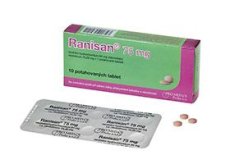
Ranisan is a medicinal product with antiulcer properties.
 [ 1 ]
[ 1 ]
ATC classification
Indications Ranisan
Indications include: gastric ulcers or duodenal ulcers, as well as reflux esophagitis, pathologies with high levels of gastric acidity, and gastrinoma.
Release form
Available in tablet form. One blister contains 10 tablets. The package contains 1 blister strip (75 mg tablets) or 2 (150 mg tablets).
Pharmacodynamics
The main property of the drug is its antiulcer effect. The drug helps to reduce acid production and is also a blocker of histamine receptors (H2).
Pharmacokinetics
The absorption of the drug is quite high (bioavailability is not affected by food or taking antacid drugs).
It weakly penetrates the blood-brain barrier, but it should be taken into account that the concentration of the active substance in breast milk exceeds similar indicators in blood plasma.
Excretion occurs via the kidneys. About 70% of the drug is excreted unchanged.
Dosing and administration
It should be taken orally, regardless of meals. The tablets do not need to be chewed, just washed down with water.
For duodenal ulcer or stomach ulcer during an exacerbation, a dosage of 150 mg twice a day (morning and evening) or a single dose of 300 mg before bedtime is required. If necessary, 300 mg of the medicine can be taken twice a day. The treatment course lasts 1-2 months. As a preventive measure against exacerbations, 150 mg of the medicine should be taken before bedtime.
Ulcers caused by NSAIDs should be treated with a dosage of 150 mg twice a day or 300 mg before bedtime. The medication should be taken for 2-3 months. Prevention of ulcers when taking NSAIDs - 150 mg 2 times a day.
For the treatment of postoperative ulcers, Ranisan is prescribed in a dose of 150 mg twice a day for 1-2 months.
For GERD, the prescribed dosage is 150 mg twice a day or a single dose of 300 mg before bedtime. If necessary, the dosage can be increased to 4 doses of 150 mg (the daily dose will thus be 600 mg). The treatment course lasts 2-3 months.
For gastrinoma, the initial dose is 150 mg three times a day. If necessary, the dosage may be increased.
To eliminate dyspeptic symptoms (against the background of increased gastric acidity) – such as nausea, as well as heartburn with sour belching, etc. – it is necessary to take 75 mg 1-2 times a day.
To prevent recurrence of bleeding, you need to take 150 mg of the medicine twice a day.
To prevent the development of acid-aspiration pneumonitis, the drug is taken in a dosage of 150 mg before the introduction of anesthesia (2 hours). It is also advisable to drink 150 mg of the drug in the evening, on the eve of the operation.
For patients with renal insufficiency (creatinine Cl is less than 50 ml/min), it is recommended to take 150 mg of the drug per day.
[ 3 ]
Use Ranisan during pregnancy
Taking the medicine during pregnancy is contraindicated.
Contraindications
Among the contraindications:
- breastfeeding period;
- children under 12 years of age;
- individual intolerance to ranitidine and other components of the drug;
- malignancy of peptic ulcer.
Side effects Ranisan
Taking the drug may cause the following side effects: dizziness with headaches, diarrhea, depression, allergies, exanthema, and a temporary increase in the level of serum transaminases in the liver.
Isolated reactions include skin erythema, bradycardia, angioedema, reversible leukopenia and thrombocytopenia, and hypotension.
[ 2 ]
Interactions with other drugs
Ranisan in combination with phenoxymethylpenicillin reduces the rate of absorption of the latter.
[ 4 ]
Storage conditions
The medicine should be kept in standard conditions - in a place closed from moisture, sunlight and access of children. Temperature regime - within 15-25°C.
Shelf life
Ranisan is permitted to be used for 3 years from the date of manufacture of the drug.